Best Ball Strategy Guide for Beginners: How to Win on Underdog Fantasy Football (2026)
What Is Best Ball Fantasy Football?
Best ball fantasy football is a format where you draft a roster before the NFL season and the platform automatically starts your highest-scoring players each week, with no lineup management required.
You draft a team before the season. Once the games start, the platform selects your best-performing players each week as your lineup automatically. No waiver wire. No trades. No sitting in front of your phone Sunday morning deciding whether to trust the guy with the questionable hamstring.
The interface is clean. The entry fees are flexible. Draft speeds vary from 20-second picks all the way up to 8 hours between picks. Best Ball Mania (BBM) is the flagship contest, with a $25 entry and $2 million going to the winner.
How Does Underdog Best Ball Work?
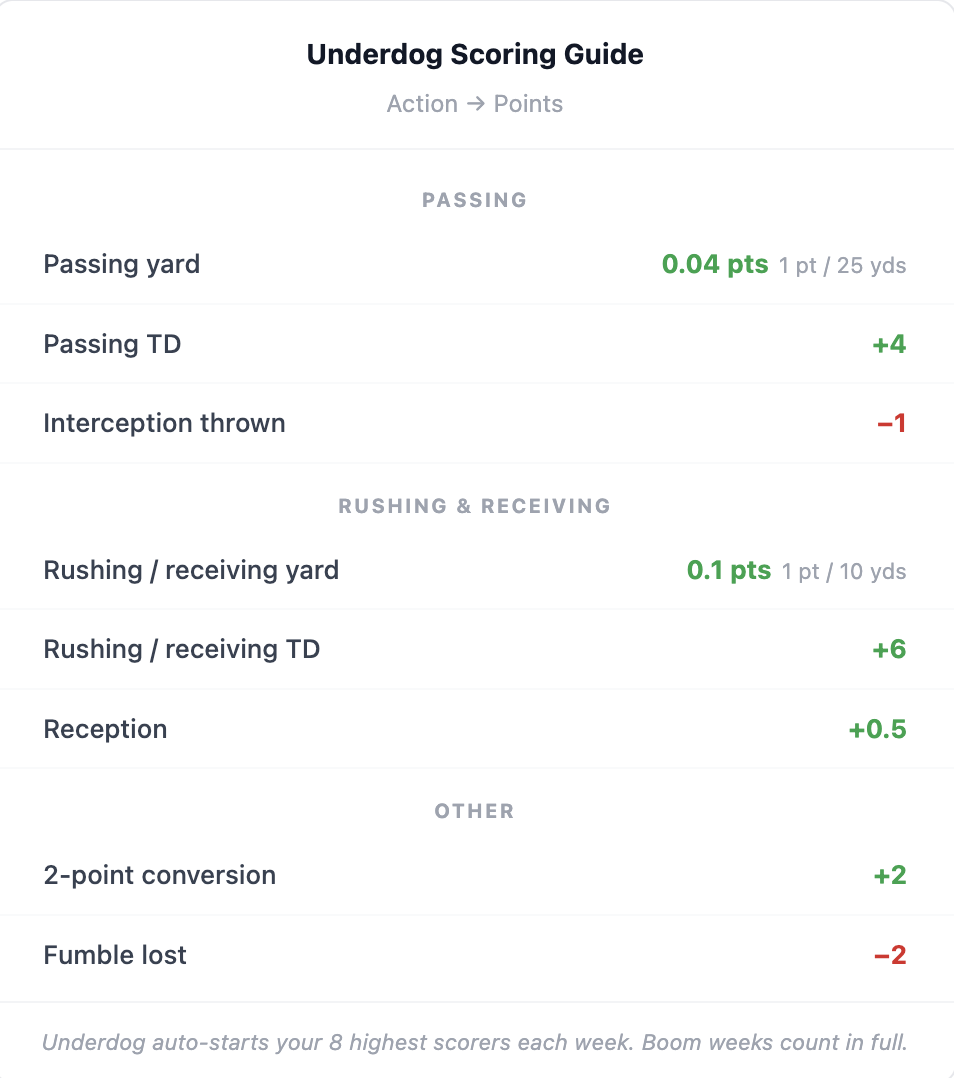
Every Underdog best ball roster is built over 18 picks. You draft QBs, RBs, WRs, and TEs in a snake draft format. Scoring is half-PPR.
Each week, Underdog automatically selects your 8 best players as your optimal lineup. In the standard 1QB format:
- 1 QB
- 2 RB
- 3 WR
- 1 TE
- 1 Flex (RB/WR/TE)
Best Ball Draft Strategy by Position
Quarterback
There are two ways to build your QB room in best ball:
The Lead QB build: Target a stud QB in the early-to-middle rounds. Pair him with one mid-tier backup later. Total: 2 QBs. You're making a conviction bet on one player delivering a top-5 season. If he hits, your QB room wins. The Depth build: Wait on QB entirely. Draft 3-4 QBs throughout the draft, none of whom costs you an early pick. I'd imagine we'll see more teams built this way in 2026. No single alpha. Instead, a room where any one of them having a big week is a win. Often this means drafting veterans likely to start early in the season and rookies who might get some run later in the year. This frees your early rounds for premium RB and WR investment. The 2025 depth build in action: Drake Maye was QB18 by ADP and finished QB2 with 359.4 points. A depth build that targeted him in the middle rounds got a top-2 QB season without spending a single early-round pick.Running Back
Has Zero RB Stopped Working in Best Ball?For years, zero-RB was the dominant best ball philosophy. Stock up on elite WRs and TEs in the early rounds, then fill your RB room with mid-round volume backs hoping for an opportunity. It makes sense. RBs were volatile, injuries were constant, and the position felt like a minefield.
But things have changed.
In 2025's Best Ball Mania (BBM VI), teams that drafted a running back in Round 1 doubled their playoff advancement rate compared to teams that didn't: 24% vs. 12%. Start your draft with two consecutive RBs and those odds jumped to 30%, compared to just 8% for teams that skipped the position in both rounds.
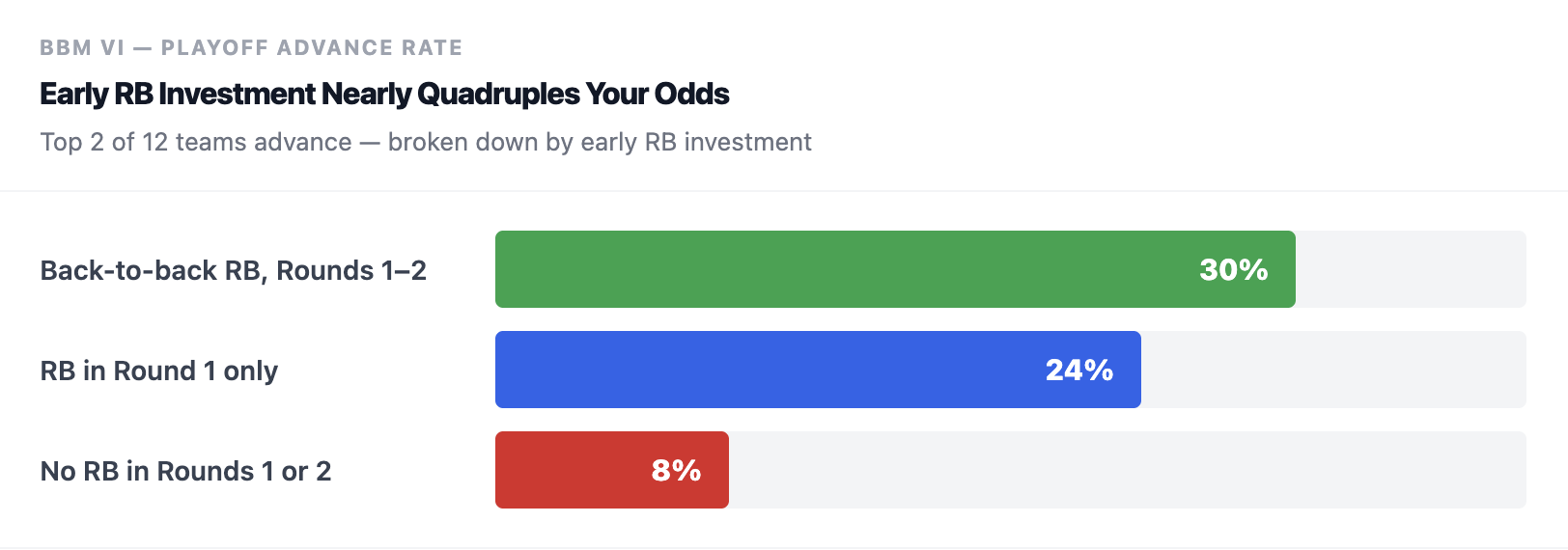 Source: 4for4, How Winners Draft Running Backs in Underdog Best Ball Mania
The historical data runs even deeper. Across all five Best Ball Mania tournaments, taking 2 RBs through Round 6 has finished above the field average in every single season. Running back is a premium position now. The ADP reflects it. The market has caught up.
The three approaches to building your RB room:
RB-heavy (4-5 RBs): Two early studs plus depth through the middle rounds. The data supports taking two consecutive early RBs as the highest-ceiling build, injuries aside. Balanced (5-6 RBs): One early RB, 2-3 in the middle rounds, 1-2 late. The most consistent performer across every BBM season. Keeps you above the field average with maximum flexibility everywhere else. Zero-RB (6-7 RBs, all mid-to-late): Still viable, but the data says you need to compensate. Draft a stud TE or stud QB into your first six rounds if you're going this route. Pushing zero-RB past Round 6 without an elite anchor elsewhere is unlikely to end well.One rule across all three: don't draft two RBs from the same backfield unless their roles are clearly independent. If you need one player hurt for the other to produce value, you're betting against yourself.
Wide Receiver
You start 3 WRs per week in 1QB drafts. Plan for 6-9 WRs on your roster.
WR is the most volatile position in best ball week to week. Depth at receiver is both insurance and upside. More WRs gives the computer more options to find peak performance across your lineup.
The three approaches:
WR-heavy (8-9 WRs): Best paired with a zero-RB or hero-RB build. You're betting on upside through volume. Needs at least 2-3 WRs with legitimate top-24 ceilings to justify the roster spots. Balanced (7-8 WRs): One WR1 or WR2 early, 3-4 in the middle rounds, 2-3 late. Gives you stacking targets and depth without going all-in on the position. WR-light (6-7 WRs): Pairs with aggressive early RB or QB investment. You're counting on your early WRs having genuine top-12 upside to hold up with fewer options behind them.The move most beginners miss: stack WR teammates. Unlike at running back, WR teammates don't cannibalize each other. You only need three WR scores per week, and a big passing game lifts every receiver in that offense. If you have a QB in a stack, target his receivers behind him. Let one offense do multiple jobs for your roster.
In the later rounds specifically, lean into WRs from teams you already own. A WR3 on your stacked QB's team might only catch 30 passes on the year, but when the offense pops, he pops with it. That correlation is the point.
Tight End
Draft 2 TEs if one is elite paired with a reliable second. Draft 3 if you're building from mid-tier options.
TE is the position where paying up early can absolutely be right, if the tight end is top-2 in his team's target share.
Test case, 2025: Trey McBride was TE1 by ADP and finished TE1 with 252.9 points, nearly 90 points clear of TE2. When the best tight end in football is identifiable before the season, that cost is justified.But that clarity is rare. The more common right move is to build wide: three mid-tier TEs who each give you weekly upside. In 2025, Dallas Goedert (155.1 pts), Tyler Warren (150.5 pts), and Harold Fannin Jr. (150.4 pts) all finished within a point of Travis Kelce, available mid-to-late at a fraction of the elite TE draft cost.
Like WR, TE teammates are stackable. You only need one TE score per week. Two tight ends in the same offense contribute without stepping on each other.
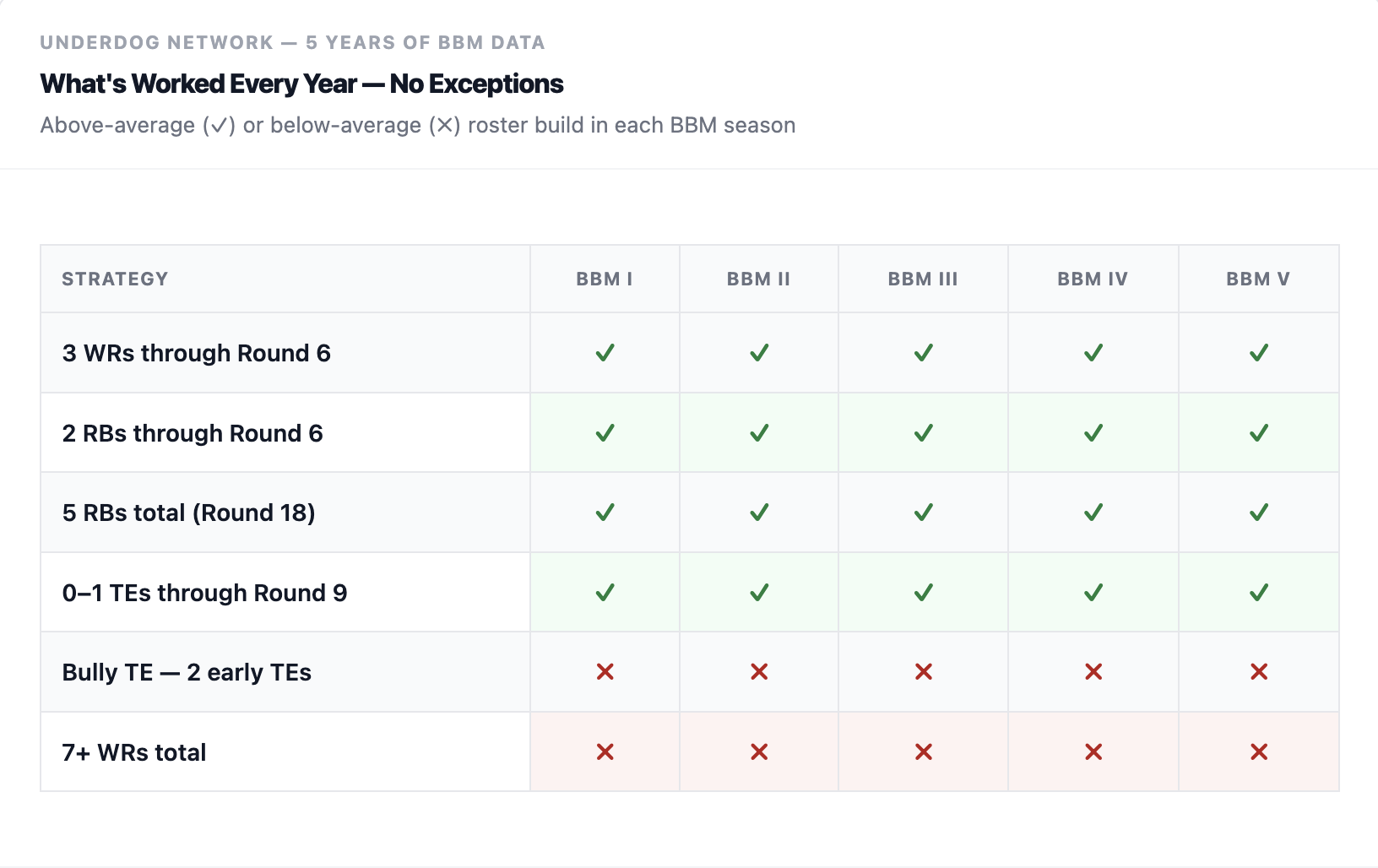 Source: Hayden Winks, What Has Worked in All 5 Years of Best Ball Mania (Underdog Network)
Stacking: The Strategy That Wins Best Ball Tournaments
Every pick in your draft is a bet. The worst best ball rosters are 18 unrelated bets: this QB hits, this RB gets carries, this receiver earns targets. Some win. Most lose. You need a lot of things to go right independently.
Stacking collapses that. When you draft a quarterback and take his pass-catchers behind him, you're not placing two bets. You're placing one: this offense is going to be elite.
Why does stacking beat unrelated picks? Imagine you draft Josh Allen, then take a wide receiver from a completely different team two rounds later. For both picks to pay off, two separate things have to go right. Allen has to carry the Bills. Your WR has to earn targets in a different scheme, under a different coordinator, from a different quarterback. Independent bets, neither one helping the other.
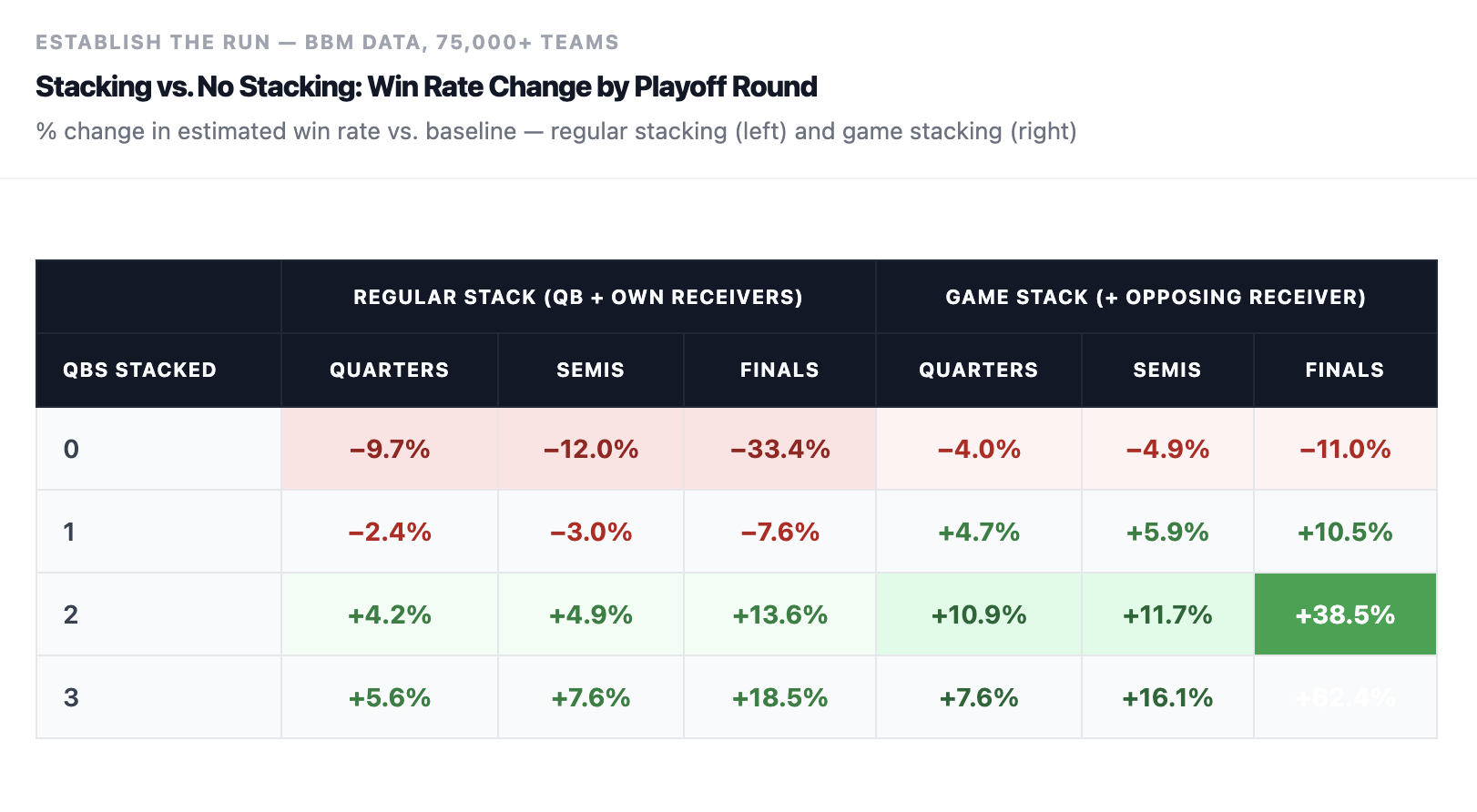
Now take Allen and go get one of his receivers instead. If Allen is delivering the season that justifies his cost, the Bills offense is rolling and your receiver benefits directly from that same result. One bet. When it hits, it hits everywhere.
The risk: stacking means when your QB's offense struggles, everything goes down together. That's real. But consider what you're playing for. Not 4th place in your pod, but 1st or 2nd. Hedged rosters with unrelated picks finish 4th consistently. Stacked rosters win more often. Aim to come in first or second 20% of the time, not fourth every time.
The question to ask before every draft: which one or two offenses do I understand better than the market does? Build there.
Source: Establish the Run, Best Ball Mania ManifestoWhat Does a Winning Best Ball Roster Look Like?
Take the QB + RB Forward build. It's built around the idea that quarterback is the highest-scoring position most weeks. Loading your QB room with depth while securing an early premium RB gives you two of the most reliable point sources in the format. Take one of the top-5 RBs early, or one of the top-5 TEs if the value is there. Pivot to WRs through the middle rounds. Circle back to QB depth late. With 4 QBs in the room, you're likely owning pass-catchers from at least one or two of those offenses, so the build lends itself naturally to stacking.
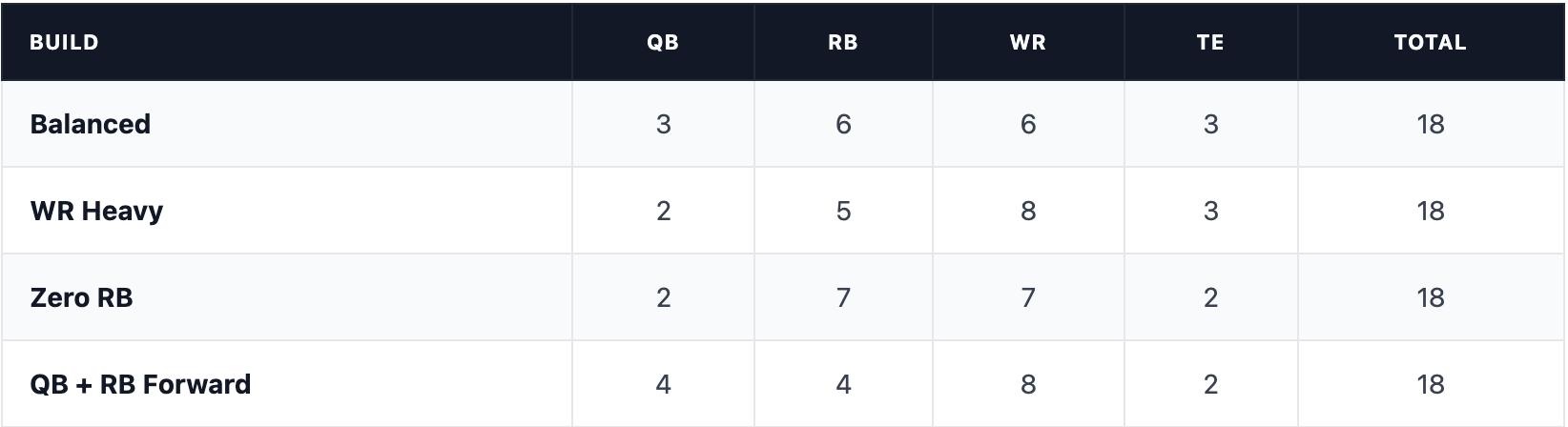
Want a second opinion on your roster? StickToTheModel's best ball trade calculator values every pick, so you can see where your build is strong and where it's thin.
When Is the Best Time to Draft?
Most drafters open Underdog in May, draft a few teams, and assume later drafts are basically the same. They're not.
Here's how the tournament works. Every 12-team pod competes against itself through Week 14. May drafters play May drafters. August drafters compete with August drafters. The top two advance. In Week 15, every advancing team gets randomized into the open playoff field, regardless of when they drafted. An April team is now competing against August teams.
That's where information becomes an edge. August drafts carry what spring drafts don't: settled depth charts, resolved training camp battles, final injury clarity. The roster you build in August reflects the NFL as it actually exists going into Week 1.
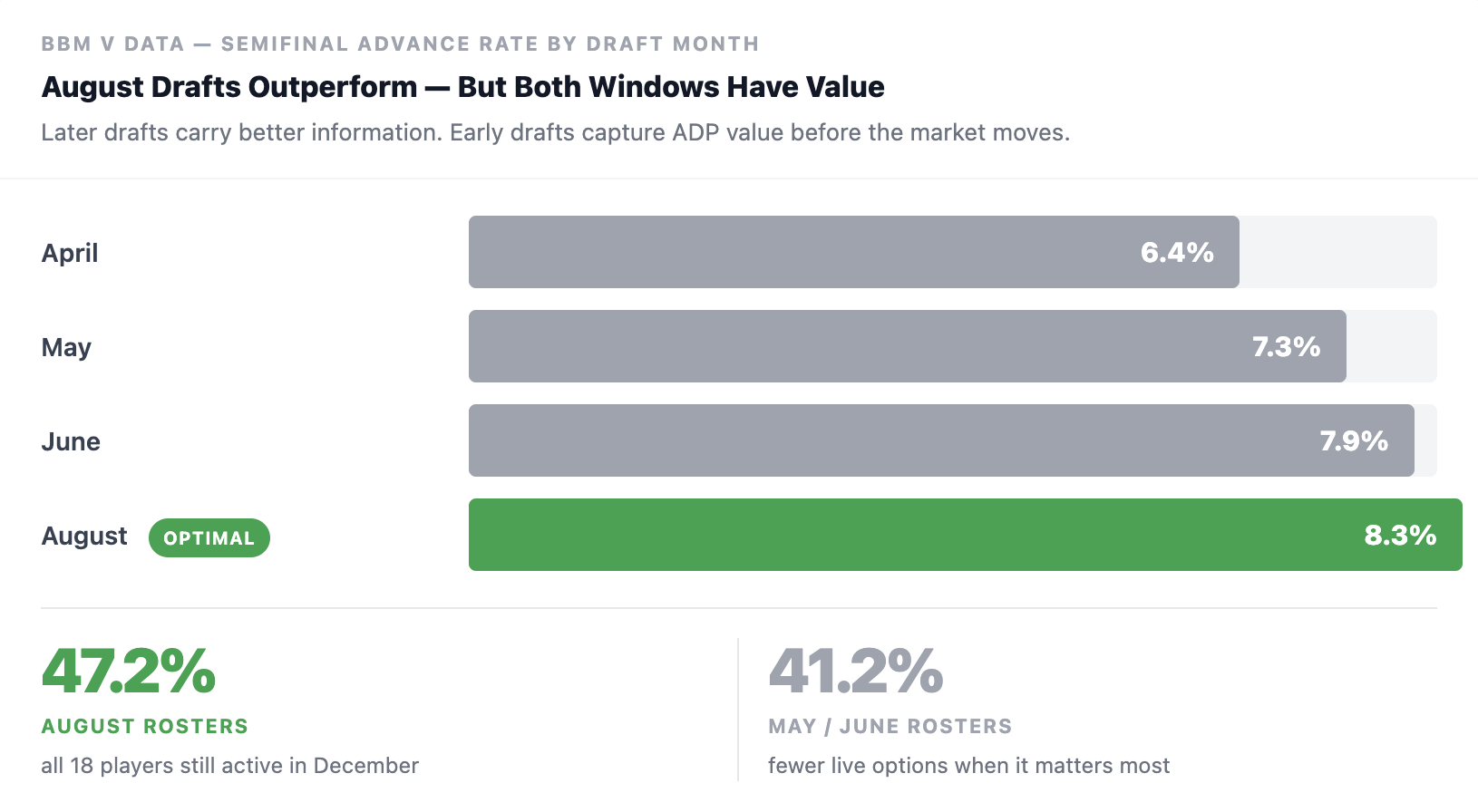
Early drafts have their own edge that August can't replicate: closing-line ADP value. ADP moves all summer as news breaks. A backup running back wins a training camp battle in June. His price catches up by July. The drafter who had him in May already locked in two months of underpriced value.
The optimal move is both windows. One or two early drafts for high-conviction plays, players you're confident in before the market moves. More drafts in August when depth charts are settled and the information is precise. Different edges, same prize pool.
Source: Establish the Run, When Is the Optimal Time to Draft Best Ball Mania Teams?The Biggest Mistake Beginners Make in Best Ball
Most people draft best ball like it's redraft. In redraft, consistency is king: the back who gets 18 carries every week, the receiver who sees 8 targets in any game script. Reliable is valuable because you set lineups every week.
In best ball, consistency is overrated.
The computer selects your best lineup automatically each week. Boom weeks get counted in full. Bust weeks get replaced by someone else on your roster. A receiver who scores 38 points one week and 6 points the next is more valuable than one who delivers 14 every single week, because the explosion game contributes fully and the quiet game gets covered by your depth.
Draft for ceiling. The floor takes care of itself.
The boom-or-bust receiver with four massive games matters more than the safe possession receiver who never disappoints. The quarterback with rushing upside who goes 40 points twice matters more than the pocket passer who reliably delivers 18. The running back who gets the goal-line work, and thus the touchdowns, matters more than the volume back who churns out yards but never finds the end zone.
In best ball, betting on ceiling is the play.
That's exactly how our 2026 best ball rankings are built: every player gets a weekly ceiling, floor, and spike-week odds instead of one season-long number, so you can see who actually wins you weeks.
How to Get Started on Underdog Fantasy
Step 1: Create your account on Underdog Fantasy. Use promo code STICKTOTHEMODEL for $50 in bonus entries. Step 2: Choose your stakes and draft. You can start drafting lineups for as little as $1 all the way up to $1K. Step 3: Set the pick clock. If you're new to best ball, start with 8-hour clocks to get a sense of ADPs and roster construction, then move on to 30-second or 20-second drafts. Step 4: Keep rankings open while you draft. Our free best ball rankings show projections, ceiling, and spike-week odds for every player, in Underdog scoring. Start drafting on Underdog FantasyTL;DR, Key Takeaways
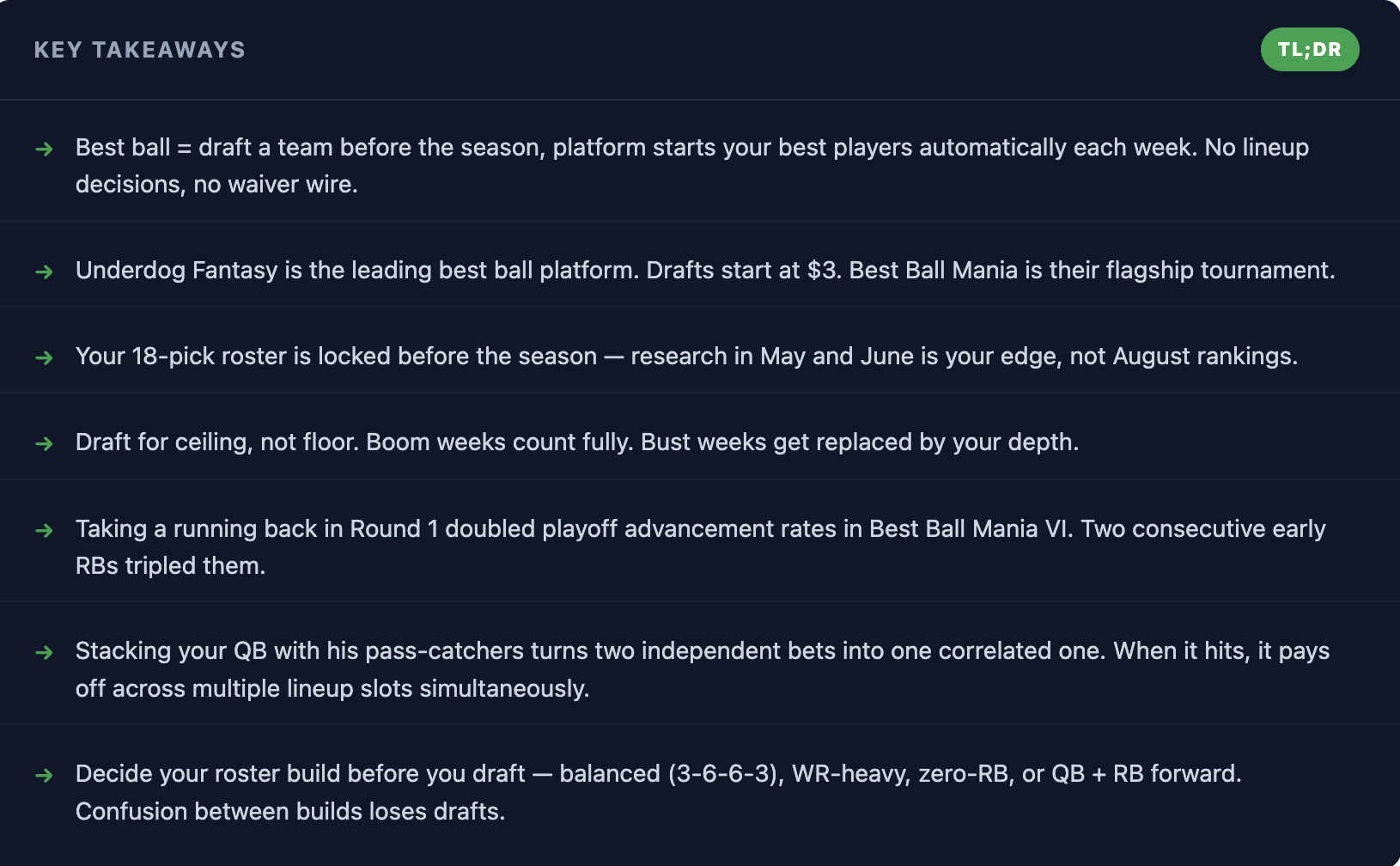
- Draft for ceiling, not consistency. The platform auto-starts your best players each week, so boom games matter more than steady ones.
- Running back matters again. Opening with two RBs through Round 6 has beaten the field average every BBM season. Zero-RB still works only if you anchor with an elite QB or TE in the first six rounds.
- Stack your QB with his pass-catchers. One big game scores in multiple lineup slots at once. It's the highest-ceiling way to build.
- Draft in both windows. A few early drafts for conviction value before ADP moves, then more in August once depth charts settle.
- Plan around 18 picks. Roughly 2-4 QBs, 4-6 RBs, 6-9 WRs, and 2-3 TEs, weighted to the build you commit to.
Frequently Asked Questions
What is best ball fantasy football?Best ball is a format where you draft a team before the season and the platform automatically starts your best players each week. No lineup decisions, no waiver wire, no trades. The entire skill lives in the draft.
How many picks do you get in Underdog best ball?Every Underdog best ball draft is 18 rounds. You draft QBs, RBs, WRs, and TEs in a snake draft format with either an 8-hour slow timer or a 30-second fast timer, depending on the contest type.
Is Underdog Fantasy legit?Yes. Underdog is one of the largest and most established best ball platforms, operating legally across most US states. Contests range from $3 entries to $250 and up. Best Ball Mania, its flagship tournament, is one of the biggest competitions in all of fantasy football.
What is Best Ball Mania on Underdog Fantasy?Best Ball Mania is Underdog's flagship best ball tournament and the premier competition in the format. Tens of thousands of teams are drafted throughout spring and summer, then compete across the NFL regular season for prize pools reaching into the millions. It's the tournament serious players build their entire summer strategy around.
What is the best best ball strategy for beginners?Start with a balanced build: roughly 3 QBs, 6 RBs, 6 WRs, and 3 TEs across 18 picks. Run slow drafts on the 8-hour timer to learn ADP. Stack your QB with his receivers in every draft. Draft for ceiling, not floor. The platform plays your best lineup automatically, so boom weeks matter more than consistency.
What is zero RB in best ball, and does it still work?Zero RB is a draft strategy where you skip running backs in the early rounds, loading up on WRs and TEs before targeting RBs in Round 5 and later. It was the dominant best ball strategy for years, but recent Best Ball Mania data shows teams without an RB in Rounds 1 or 2 advance at just 8%, compared to 30% for teams that open with two consecutive RBs. Zero RB still works, but only if you compensate with an elite TE or QB in your first six rounds.
What is stacking in best ball?Stacking means drafting a quarterback and his pass-catchers from the same team. When your QB has a big game, your stacked receivers benefit directly, so the same play scores points in multiple lineup slots at once. It's the highest-ceiling roster construction approach in best ball and the strategy most associated with winning tournaments.
What's the difference between 1QB and superflex best ball?In 1QB drafts you start one quarterback per week. In superflex, one additional flex spot can be filled by a QB. Superflex leagues value QBs dramatically higher, so plan for at least three starting-caliber QBs and draft them earlier than you would in a standard format.
Is best ball good for fantasy football beginners?Yes, especially for fans who follow the NFL closely in the offseason. There's no weekly lineup stress, and your research before the season holds value for 17 weeks instead of evaporating on waiver day. The deeper your football knowledge, the better your teams will be.
What is the Underdog Fantasy promo code?Use promo code STICKTOTHEMODEL when signing up for Underdog Fantasy. New accounts get $50 in bonus entries.
When should I start drafting on Underdog?Drafts open in the spring. Earlier drafts let you find value before situations get fully priced in, since scheme installs, depth chart competitions, and OTA reports haven't been reflected in ADP yet. Later drafts have more accurate pricing but less opportunity to get ahead of the market. Most serious players draft throughout the summer, treating each wave of news as a chance to identify where the consensus is wrong.
Sources
- Hayden Winks, What Has Worked in All 5 Years of Best Ball Mania (Underdog Network)
- 4for4, How Winners Draft Running Backs in Underdog Best Ball Mania (BBM VI data)
- Establish the Run, Best Ball Mania Manifesto
- Establish the Run, When Is the Optimal Time to Draft Best Ball Mania Teams?
- Underdog Fantasy, Best Ball Mania rules and scoring