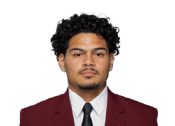
Jayden Maiava
 USC#63 overall
Scouting Report
Once written off as a developmental 2027 name, Maiava forced his way into 2026 draft conversations by leading the Big Ten in passing yards, yards per attempt, yards per completion, and EPA in his second USC season under Lincoln Riley. He grades as a second-round prospect, projecting a below-average starter with above-average upside. He fits the modern game as an air-raid quick-game operator: a lightning release, elite pressure-to-sack rate, and a knack for resetting his base under duress to deliver accurate balls. He flashes explosive plays in tight windows with excellent touch and velocity nuance, and there is some Caleb Williams to his off-platform creativity when forced out of structure. He has thrown over 800 career attempts, and his turnover-worthy play rate has fallen every year. The concerns are real: fringe-average arm strength caps the deep ball past 40 yards, his lower half lags behind his release, and inconsistent weight transfer hurts far-hash throws to his left. He can narrow his base prematurely and is not an anticipatory full-field reader, and his under-center footwork needs work after a shotgun-heavy college base. He is a safe decision-maker who attacks man coverage, and the floor as a structured quick-game passer is intriguing even if the Round 1 ceiling is debatable.
NFL Comparison
Caleb Williams: similar USC lineage and off-platform creativity under pressure, though Maiava lacks the same arm and athletic ceiling; Dak Prescott: dense-framed pocket passer who wins on poise, structure, and sack avoidance rather than elite tools; Geno Smith: efficient quick-game distributor whose value rises in a timing-based, air-raid-adjacent system
Draft Movement
Up 2 spots since Jun 8
The Tape
Strengths
- Lightning-quick release that drives elite efficiency
- elite pressure-to-sack rate (8.2%) and consistent sack avoidance
- low turnover-worthy play rate (3.5%) that has dropped every season
- led the Big Ten in passing yards, YPA, YPC, and EPA in 2025
- strong EPA/DB of 0.51 with a 55.6% success rate
- excellent touch and velocity modulation to layer throws into tight windows
- resets his base under pressure to keep accuracy
- dense, balanced athleticism to break sacks and add as a runner (six rushing TDs in 2025)
Weaknesses
- Fringe-average arm strength that limits the deep ball, with a visible decline past 40 yards
- lower-half mechanics lag behind his release with poor weight transfer
- struggles throwing to his left, overstriding on far-hash attempts
- tends to narrow his base prematurely, causing accuracy lapses on key downs
- not an anticipatory thrower and slow getting through full-field progressions
- under-center footwork is underdeveloped after a shotgun-based college scheme
- limited scrambling upside relative to his archetype
- turnover-prone in a few losses (two INTs each vs Oregon and TCU)
College Stats
2024 (USC, redshirt soph): first season as primary starter after transitioning from backup, showed major growth in command and execution; 2025 (USC, junior): 3,431 pass yds, 23 pass TD, 8 INT entering the bowl plus 6 rushing TD and 157 rush yds, led Big Ten in pass yards/YPA/YPC/EPA; advanced 2025 splits: 7.0% big-time throw, 3.5% turnover-worthy play, 8.2% pressure-to-sack, 2.94 time to throw, 0.51 EPA/dropback, 55.6% success rate
College Market Value
Our model prices him at $2.58M on the open college market, built from production, pedigree, role and USC's program money. No credible deal has been reported for him this season.
The college fantasy model projects 22.0 PPG (QB6), after 22.6 PPG across 6 games last year.
Every P4 player priced, math public: College players & NIL · Roster spend
Measurables
Awards & Honors
Grades as a second-round prospect for 2027; Big Ten leader in passing yards, yards per attempt, yards per completion, and EPA (2025); early Heisman candidate buzz entering 2026