Build a Player - spin five NFL or college teams, build one player
Updated Oct 20, 2026. Every rating is a real 2025 stat, 32 NFL teams and 136 FBS schools; the position of the day rotates at midnight.
Rules & FAQ
Frequently asked questions
Is Build a Player free?
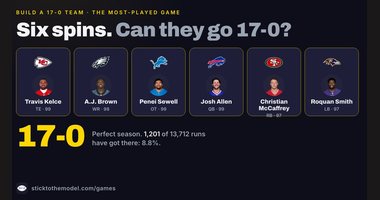
Yes. Free, no login, and no limit: spin as many players as you like, NFL or college, any position. Same as the 17-0 challenge.
Does Build a Player reset daily?
The position of the day rotates every morning: wide receiver, running back, tight end, quarterback, edge rusher, linebacker, cornerback, safety, interior lineman, then around again. It is the default when you open the game and the leaderboard ranks every build made that day. The spins themselves are random every play, the same as the 17-0 challenge, so your five teams are yours alone, and you can spin another the moment one is graded.
Can I pick the position?
Yes. The setup screen offers all nine positions, with today's position selected. Change it whenever you like and spin a fresh set of teams each time. College offers the four offensive positions.
Can I build a QB?
Yes. Tap QB on the position row and spin five teams to build a quarterback from five traits: arm, accuracy, mobility, deep ball and poise under pressure. Every rating is a real 2025 stat. College has a QB build too, from accuracy, big arm, efficiency, ball security and rushing.
Can I build a WR, RB or TE?
Yes. Tap WR to build a wide receiver from speed, size, hands, route running and after the catch, RB to build a running back from speed, size, vision, power and receiving, or TE for a tight end. The five defensive positions work the same way in the NFL.
Can I build a college player?
Yes. The opening screen asks NFL or College. College spins one of 136 FBS schools instead of an NFL team, and its five traits are production stats from the 2025 season (there is no combine data in college, so no speed or size trait): for a receiver or tight end that is big plays, hands, efficiency, volume and chains. Same five spins, same grading against the best build your schools allowed.
Do I choose which trait a player gives me?
Yes. The spin only decides the team. Each of that team's players shows his rating for every open trait he has a qualifying stat for, so you see whether he is your speed or your hands before you commit, and you tap the one you want him to fill. One player per spin, one trait per player.
Can I re-spin a team?
No. Same rule as the 17-0 challenge: the team you land on is the team you pick from, and a team that has come up once does not come up again in the same build. The reel only ever lands on teams with at least one player rated in a trait you still have open, so there is always somebody to pick. The one exception is the 17-0 rule too: if a team somehow has nobody to offer, you get a re-spin and that team stays used.
Which positions can I build?
Nine in the NFL: wide receiver, running back, tight end, quarterback, edge rusher, linebacker, cornerback, safety and interior defensive lineman. Four in college: receiver, back, tight end and quarterback. Each has its own five traits: an NFL receiver or tight end is speed, size, hands, route running and after the catch; a back is speed, size, vision, power and receiving; a quarterback is arm, accuracy, mobility, deep ball and poise under pressure; an edge rusher is speed, size, pass rush, finishing and run stop; a linebacker is speed, size, tackling, range and coverage; a cornerback is speed, size, coverage, ball skills and tackling; a safety is speed, range, coverage, ball skills and tackling; an interior lineman is speed, size, pass rush, run stop and motor.
Where do the ratings come from?
Real numbers from the 2025 season, one named stat per trait: NFL stats plus the combine for the NFL, game-by-game production for college. A rating is that player's percentile among players at his position for that stat, 0 to 100. Nothing is a scout's opinion and nothing is invented.
Can I share what I built?
Yes. Every finished build gets a share card with the five teams you spun, the five donors, and the grade, ready to post or download.
How it works
Spin. Pick NFL or college and a position: wide receiver, running back, tight end, quarterback, and in the NFL also edge rusher, linebacker, cornerback, safety or interior lineman (the day's position is selected for you; they rotate by day). That position has five traits, all open. The reel spins one of the 32 NFL teams (or one of 136 FBS schools, if you chose college), the same slot-machine reel as the 17-0 challenge, and it starts spinning the moment you press play. The reel only lands on teams with at least one player rated in a trait you still have open, and a team that comes up once does not come up again in the same build.
Pick. The team you land on shows every one of its players at the position, with his face, his name and his 0 to 100 rating for each of the five traits for every open trait he has a qualifying stat for (a trait he has no number for is simply not offered, and traits you have already filled drop off his row). Each row says in words what he would fill, like "Fills your deep ball at 96".
Choose. Tap the trait you want him to give you, right on his row. That is the whole trick of the game: the team is luck, the assignment is yours. Take the burner for speed now, or hold speed open and hope a faster man comes up on spin four. One player per spin, and the reel spins again the moment you place him. Speed from one roster, hands from another, route running from a third.
Build. The fifth placement builds him on the spot. Your creation gets a weighted score, a grade, the best score anyone could have reached from the five teams you spun, and a share card naming the teams and the donors.
Grade. Then spin another. There is no limit: the reveal offers a fresh set of five teams in the same league and position, or a trip back to the setup to change either. Your build in progress is saved, so a refresh brings it back, and the leaderboard ranks every build made that day. Nothing is behind a login.
NFL or College. The opening screen asks which. NFL spins the 32 teams and rates players on 2025 stats plus the combine. College spins 136 FBS schools and rates players on 2025 production only, since there is no combine in college: no speed or size trait, and so no body-mismatch penalty either. Both are graded the same way, and the leaderboard takes both.
Build a QB, WR, RB or defender: the five traits at each position
Every rating in this game is one named stat from the 2025 season or the combine, turned into a percentile among active players at that position: a 100 is the best man in the pool at that one thing, a 50 is the median. No scout grades, no invented numbers. The percentage after each trait is its weight in the final score. A player makes a board only if he clears the sample floor of every stat trait, so a receiver with 12 targets is not on the receiver board. A starter with no 40 time on record (he skipped the drill at the combine and we have no pro day time) stays on the board with no speed rating. The reel skips any team with nobody on the board (the thinnest board today is LB, 28 of 32 teams).
NFL wide receiver
- Speed (20%): 40-yard dash, combine or pro day, lower is better. 70 players qualify across 32 of 32 teams.
- Size (15%): Height and weight. 80 players qualify across 32 of 32 teams.
- Hands (20%): Drop rate, 40+ targets, lower is better. 80 players qualify across 32 of 32 teams.
- Route running (25%): Yards per route run, 200+ routes. 80 players qualify across 32 of 32 teams.
- After the catch (20%): Yards after catch per reception, 25+ catches. 80 players qualify across 32 of 32 teams.
NFL running back
- Speed (20%): 40-yard dash, combine or pro day, lower is better. 45 players qualify across 31 of 32 teams.
- Size (15%): Height and weight. 48 players qualify across 32 of 32 teams.
- Vision (25%): Rush yards over expected per carry, 80+ carries. 48 players qualify across 32 of 32 teams.
- Power (20%): Broken tackles per 100 touches. 48 players qualify across 32 of 32 teams.
- Receiving (20%): Receiving yards per game. 48 players qualify across 32 of 32 teams.
NFL tight end
- Speed (15%): 40-yard dash, combine or pro day, lower is better. 39 players qualify across 29 of 32 teams.
- Size (20%): Height and weight. 44 players qualify across 31 of 32 teams.
- Hands (20%): Drop rate, 30+ targets, lower is better. 44 players qualify across 31 of 32 teams.
- Route running (25%): Yards per route run, 150+ routes. 44 players qualify across 31 of 32 teams.
- After the catch (20%): Yards after catch per reception, 20+ catches. 44 players qualify across 31 of 32 teams.
NFL quarterback
- Arm (20%): Average intended air yards, 100+ attempts. 41 players qualify across 32 of 32 teams.
- Accuracy (25%): Completion rate over expected, 150+ attempts. 41 players qualify across 32 of 32 teams.
- Mobility (15%): Rushing yards per game, 4+ games. 41 players qualify across 32 of 32 teams.
- Deep ball (15%): Average completed air yards, 100+ attempts. 41 players qualify across 32 of 32 teams.
- Poise (25%): EPA per dropback under pressure, 100+ attempts. 41 players qualify across 32 of 32 teams.
NFL edge rusher
- Speed (15%): 40-yard dash, combine or pro day, lower is better. 82 players qualify across 31 of 32 teams.
- Size (15%): Height and weight. 94 players qualify across 31 of 32 teams.
- Pass rush (25%): Pressures per 100 defensive snaps, 300+ snaps. 94 players qualify across 31 of 32 teams.
- Finishing (25%): Sacks per game, 300+ snaps. 94 players qualify across 31 of 32 teams.
- Run stop (20%): Tackles for loss per game, 300+ snaps. 94 players qualify across 31 of 32 teams.
NFL linebacker
- Speed (20%): 40-yard dash, combine or pro day, lower is better. 52 players qualify across 28 of 32 teams.
- Size (15%): Height and weight. 59 players qualify across 32 of 32 teams.
- Tackling (20%): Missed tackle rate, 40+ tackles, lower is better. 59 players qualify across 32 of 32 teams.
- Range (25%): Tackles per game, 300+ snaps. 59 players qualify across 32 of 32 teams.
- Coverage (20%): Passer rating allowed when targeted, 25+ targets, lower is better. 59 players qualify across 32 of 32 teams.
NFL cornerback
- Speed (20%): 40-yard dash, combine or pro day, lower is better. 78 players qualify across 31 of 32 teams.
- Size (15%): Height and weight. 86 players qualify across 31 of 32 teams.
- Coverage (30%): Passer rating allowed when targeted, 30+ targets, lower is better. 86 players qualify across 31 of 32 teams.
- Ball skills (20%): Interceptions plus passes defended per 100 targets, 30+ targets. 86 players qualify across 31 of 32 teams.
- Tackling (15%): Missed tackle rate, 25+ tackles, lower is better. 86 players qualify across 31 of 32 teams.
NFL safety
- Speed (20%): 40-yard dash, combine or pro day, lower is better. 62 players qualify across 29 of 32 teams.
- Range (20%): Tackles per game, 300+ snaps. 70 players qualify across 31 of 32 teams.
- Coverage (25%): Passer rating allowed when targeted, 25+ targets, lower is better. 70 players qualify across 31 of 32 teams.
- Ball skills (20%): Interceptions plus passes defended per 100 targets, 25+ targets. 70 players qualify across 31 of 32 teams.
- Tackling (15%): Missed tackle rate, 30+ tackles, lower is better. 70 players qualify across 31 of 32 teams.
NFL interior lineman
- Speed (10%): 40-yard dash, combine or pro day, lower is better. 80 players qualify across 31 of 32 teams.
- Size (25%): Height and weight. 86 players qualify across 32 of 32 teams.
- Pass rush (25%): Pressures per 100 defensive snaps, 300+ snaps. 86 players qualify across 32 of 32 teams.
- Run stop (25%): Tackles for loss per game, 300+ snaps. 86 players qualify across 32 of 32 teams.
- Motor (15%): Tackles per game, 300+ snaps. 86 players qualify across 32 of 32 teams.
A rating measures the stat and nothing else. Speed is the 40 a player ran at the combine, which is why a veteran who ran 4.3 at 22 still rates fast at 30. Size rewards tall and heavy together, so a 6-foot-4, 230-pound receiver rates near 100 whether or not he plays big.
College traits are all production, aggregated from every 2025 game a player played for his school. A sample floor applies here too: 30 targets for a receiver, 60 carries for a back, 20 targets for a tight end, 120 attempts for a quarterback.
College wide receiver
- Big play (20%): 20+ yard catches per target, 30+ targets. 444 players qualify across 136 of 136 schools.
- Hands (20%): Catch rate, 30+ targets. 444 players qualify across 136 of 136 schools.
- Efficiency (25%): EPA per target, 30+ targets. 444 players qualify across 136 of 136 schools.
- Volume (15%): Receiving yards per game, 30+ targets. 444 players qualify across 136 of 136 schools.
- Chains (20%): First downs per target, 30+ targets. 444 players qualify across 136 of 136 schools.
College running back
- Explosive (20%): 10+ yard runs per carry, 60+ carries. 256 players qualify across 135 of 136 schools.
- Power (15%): Stuffed rate (runs for no gain or a loss), 60+ carries, lower is better. 256 players qualify across 135 of 136 schools.
- Efficiency (25%): EPA per carry, 60+ carries. 256 players qualify across 135 of 136 schools.
- Workload (20%): Rushing yards per game, 60+ carries. 256 players qualify across 135 of 136 schools.
- Receiving (20%): Receiving yards per game, 60+ carries. 256 players qualify across 135 of 136 schools.
College tight end
- Big play (20%): 20+ yard catches per target, 20+ targets. 160 players qualify across 119 of 136 schools.
- Hands (20%): Catch rate, 20+ targets. 160 players qualify across 119 of 136 schools.
- Efficiency (25%): EPA per target, 20+ targets. 160 players qualify across 119 of 136 schools.
- Volume (15%): Receiving yards per game, 20+ targets. 160 players qualify across 119 of 136 schools.
- Chains (20%): First downs per target, 20+ targets. 160 players qualify across 119 of 136 schools.
College quarterback
- Accuracy (25%): Completion rate, 120+ attempts. 150 players qualify across 133 of 136 schools.
- Big arm (15%): Yards per attempt, 120+ attempts. 150 players qualify across 133 of 136 schools.
- Efficiency (25%): EPA per dropback, 120+ attempts. 150 players qualify across 133 of 136 schools.
- Ball security (20%): Interception rate, 120+ attempts, lower is better. 150 players qualify across 133 of 136 schools.
- Rushing (15%): Rushing yards per game, 120+ attempts. 150 players qualify across 133 of 136 schools.
How the score works
Your score is the weighted average of the five donor ratings, using the weights above. Route running and hands carry more for a receiver than size does; size counts for more on a tight end; accuracy and poise carry the most for a quarterback. Two adjustments sit on top. Synergy adds 3 points when two of your traits come from the same real player, because you built a man who actually exists. Body mismatch takes 4 points away when your speed donor and your size donor are 40 or more pounds apart on the roster, because a 165-pound burner's speed does not fit on a 240-pound frame. Quarterbacks have no speed or size trait, and safeties no size trait, so they never pay it.
The defensive positions are NFL only and their production traits come from Pro Football Reference's advanced defense table, with a floor of 300 defensive snaps for anything per snap or per game (pass rush is pressures per 100 snaps; finishing is sacks per game; run stop is tackles for loss per game; range and motor are tackles per game) and a target floor for coverage (passer rating allowed when targeted, lower is better) and ball skills (interceptions plus passes defended per 100 targets). Tackling is missed tackle rate, lower is better, over a minimum number of tackles. A rotational rusher with 150 snaps cannot top the pass rush board, and a nickel back targeted eight times cannot top coverage.
The grade bands: A+ at 90+, A at 84+, A- at 78+, B+ at 72+, B at 66+, B- at 60+, C+ at 54+, C at 48+, D below 48. The reveal also shows the best possible score from the five teams you actually spun, found by checking every way of sending one player from each of those teams to a different trait, so your percent-of-best is an honest number about your choices and not about your luck.
Build a player vs the 17-0 challenge
Same reel, same rules, different thing at the end. The 17-0 challenge spins six teams and asks you to draft one star from each into an undefeated roster; you can play it any time with NFL, college or all-time legends. Build a Player spins five teams, NFL or college, and asks you to assemble one man from them, one player and one trait per spin, in whatever order you choose, and grades the result against the best build those five teams allowed. If you like arguing about whether speed or hands matters more, this is your game. If you like arguing about which team's best player is best, play the 17-0. Both are on the daily NFL games page with a dozen others, all free.
Built your guy for the day? The 17-0 challenge spins six random teams and asks you to draft an undefeated roster, the NFL Grid game is a nine-cell player puzzle, Redo the Call is an NFL play calling game set in a real NFL ending, and all daily NFL games are free with no login.